

Sensitive Skin Care in Tucson: Desert-Proof Treatments for a Calm, Clear Complexion

Quick Summary:
Living in Tucson means navigating UV index readings that regularly hit 11+, monsoon-season humidity spikes, and summer temperatures above 110°F — a combination that can push sensitive skin into near-constant reactivity. The good news: professional sensitive skin care in Tucson doesn't have to mean avoiding every treatment. At Siren Skin Care, licensed esthetician Catie Fisher specializes in gentle, results-driven services that calm reactive skin rather than irritating it. This guide explains what's actually causing your flare-ups and which spa treatments are safe — and effective — for sensitive Tucson skin.
Why Tucson's Climate Challenges Sensitive Skin
If you've moved here from a more temperate state and noticed your skin acting up within weeks, you're not imagining it. Tucson's environment is genuinely extreme — and for people with sensitive skin, it can feel like the desert is waging a personal war on your complexion.
The Sonoran Desert sits at about 2,400 feet above sea level. That elevation means the atmosphere above you is thinner, which translates directly into higher UV intensity. While the rest of the country is dealing with UV index readings in the 6–8 range on a clear summer day, Tucson regularly hits 11 and 12. That's in the "extreme" category — the kind of UV exposure that breaks down collagen, disrupts the skin barrier, and triggers inflammatory responses even in people who don't normally consider themselves sensitive.
Layered on top of that is Tucson's monsoon season, which runs from late June through September. The relative humidity swings from under 20% during the dry months to sudden 60%+ spikes during storm events. That kind of humidity whiplash confuses your skin's moisture regulation, can cause sweat-mixed-with-sunscreen to clog pores, and often sets off redness and irritation in people who are already reactive.
Then there are the haboobs — massive dust storms that roll through the valley carrying fine particulate matter that settles on skin, gets trapped in pores, and can cause breakouts and sensitivity reactions for days after the storm passes.
All of this makes sensitive skin care in Tucson a specific discipline, not just a general skincare concern.
What Sensitive Skin Actually Means
"Sensitive skin" is one of the most overused phrases in beauty marketing, so it's worth being precise. Sensitive skin refers to skin that reacts disproportionately to stimuli that wouldn't bother most people: fragrance, certain preservatives, heat, friction, alcohol-based products, or even tap water.
True sensitive skin often has one or more underlying causes:
A compromised skin barrier: The outermost layer of your skin (the stratum corneum) is supposed to keep moisture in and irritants out. When it's damaged — by over-exfoliation, harsh cleansers, or chronic sun exposure — everything gets through more easily.
Rosacea: A chronic inflammatory condition that causes redness, visible blood vessels, and a tendency to flush easily. Tucson's heat and UV are two of rosacea's most consistent triggers.
Contact dermatitis: Reactive skin that flares when it encounters specific allergens or irritants.
Post-procedure sensitivity: After certain treatments (strong chemical peels, laser, or microneedling), skin goes through a temporary sensitive phase.
Understanding which category you fall into matters because not all sensitive skin is treated the same way.
The Desert Aggressors Triggering Your Reactions
Even people who never had sensitive skin in wetter climates can develop it after spending a few summers in Tucson. Here are the main culprits:
Chronic UV damage. The cumulative effect of Tucson's UV isn't just about sunburn. Over time, UV exposure thins the skin, impairs barrier function, and creates chronic, low-grade inflammation. This is why many longtime Tucson residents find their skin becomes more reactive with each passing year.
Extreme dehydration. When the ambient humidity drops below 15% (common in May and June), your skin loses transepidermal water at an accelerated rate. Dehydrated skin is a compromised skin barrier waiting to happen.
Sunscreen pilling and sweating. In 110°F heat, most people apply sunscreen multiple times a day — which is absolutely the right move. But heavy SPF products that aren't designed for the desert can mix with sweat, pill on the skin, and create a film that traps heat and clogs pores. This leads to milia, congestion, and a specific kind of summer breakout that's common in Tucson and confuses people who've never experienced it before.
Dust and particulate matter. After a haboob, the fine dust settles on every surface — including your face. That particulate matter is not just dirt. It contains minerals, pollutants, and allergens that can trigger reactions in sensitive skin types.
Product "hopping" during monsoon season. The humidity shift during monsoon season makes some people feel like their skin is suddenly oily, so they switch to drying products. That disrupts the barrier even further.
Professional Sensitive Skin Care Treatments in Tucson
This is where a lot of people with sensitive skin get stuck: they assume they can't get professional treatments without triggering a reaction. In most cases, that's not true — it just means you need a licensed esthetician who understands sensitive skin and can modify protocols accordingly.
At Siren Skin Care, every service begins with a skin assessment. Catie Fisher has worked extensively with reactive skin types in Tucson's climate, and she adapts treatments to what your skin can actually handle — not just what the standard protocol calls for. You can view our full treatment menu on the services page to see what we offer.
The two professional treatments most frequently recommended for sensitive skin in Tucson are dermaplaning and specific formulations of chemical peels.
Dermaplaning: Gentle Exfoliation That Works
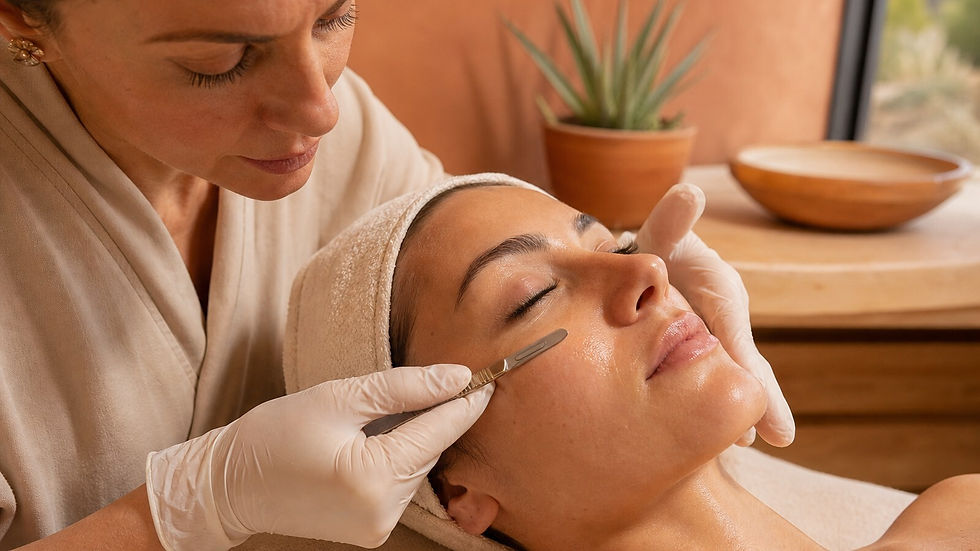
Dermaplaning is a manual exfoliation technique that uses a sterile surgical scalpel to gently remove the top layer of dead skin cells and vellus hair (peach fuzz) from the face. It sounds intense — it isn't.
Done correctly, dermaplaning is one of the gentler professional exfoliation options available. There's no acid, no heat, no suction, and no recovery downtime. The process is physical and controlled, meaning an experienced esthetician can gauge exactly how much pressure to use and adjust for sensitive areas.
For sensitive skin types in Tucson, dermaplaning offers several specific benefits:
Better SPF absorption. One of the biggest problems for Tucson residents with sensitive skin is sunscreen effectiveness. When dead skin cells and peach fuzz create an uneven surface, sunscreen doesn't apply smoothly and can pill. After dermaplaning, SPF applies in a thin, even layer that actually adheres to skin properly. For a city where UV is a daily hazard, this matters.
Reduced product buildup. Sensitive skin often reacts to product residue that accumulates on the surface over time. Dermaplaning clears that slate without introducing acids or active ingredients that could trigger a reaction.
Smoother skin texture without irritation. Many sensitive skin clients have tried acid exfoliants and found them too harsh. Dermaplaning achieves a similar smoothing effect through physical means, which works well for people who can't tolerate acids.
Siren Skin Care offers dermaplaning starting at $85. A consultation is always included, and Catie will assess your skin before proceeding.
One important note: dermaplaning is not recommended if you have active acne breakouts, open wounds, or are in an active rosacea flare. Timing matters. Our FAQ page has more detail on who dermaplaning is right for.
Chemical Peels: Can Sensitive Skin Handle Them?
The short answer is yes — with the right peel and the right esthetician.
Not all chemical peels are created equal. There's a wide spectrum between a gentle lactic acid peel (hydrating, low-irritation, suited to sensitive skin) and a deep TCA peel (requires significant downtime and should only be done by a dermatologist). The key is matching the peel strength to what your skin can actually tolerate.
At Siren Skin Care, we offer the Advanced Jessner Chemical Peel ($225). The Jessner formula combines lactic acid, salicylic acid, and resorcinol in a solution designed to exfoliate at multiple skin depths. It's a medium-depth peel — more effective than entry-level options, but formulated in a way that produces controlled, predictable results.
For sensitive skin, there are a few important considerations before scheduling a chemical peel:
Time it right. Don't schedule a peel during Tucson's peak summer heat if you're going to be outdoors for work or daily activities. Your skin will be temporarily more photosensitive after a peel. Monsoon shoulder season (late September through November) is ideal in Tucson.
Prep your barrier first. Coming in for a peel when your skin barrier is already compromised (from sun damage, dehydration, or recent irritation) is a setup for a difficult recovery. Catie may recommend a preparatory treatment session before scheduling your peel.
Discontinue retinoids and active serums. If you're using prescription or over-the-counter retinol, stop at least 7 days before your peel appointment. Using actives alongside a chemical peel increases the risk of over-exfoliation.
Post-peel care in Tucson is also more demanding than in other climates. You'll need to be religious about SPF (minimum SPF 50, no exceptions), stay hydrated, and avoid any activity that causes intense sweating in the first 48–72 hours after treatment.
Building a Summer Skincare Routine for Tucson's Climate

Professional treatments are only part of the equation. What you do at home — especially during the brutal May-through-September stretch — significantly affects how your skin behaves.
Morning:
Gentle, fragrance-free cleanser (avoid anything foaming or alcohol-based)
Light, hydrating serum with hyaluronic acid or ceramides
Fragrance-free SPF 50+ that's lightweight enough to not pill in heat (mineral-based formulas with zinc oxide tend to work well in Tucson's humidity extremes)
Evening:
Double cleanse after any outdoor time to clear sunscreen residue and dust
A calming toner if you use one (look for centella asiatica, chamomile, or niacinamide — all good for reducing redness)
A barrier-repair moisturizer with ceramides or squalane
Weekly:
One gentle exfoliation session at home (a soft konjac sponge or a mild enzyme mask)
A hydrating sheet mask after monsoon dust events
The Siren Skin Care about page has more on Catie's approach to building personalized skincare routines.
What to Skip If You Have Sensitive Skin in the Desert
A few common mistakes that make sensitive skin worse in Tucson:
Heavy scrubs and physical exfoliants. Walnut shell scrubs, apricot scrubs, and sugar scrubs with large, irregular particles create micro-tears in sensitive skin. Save the exfoliation for professional treatments.
Fragrance in everything. Fragrance is one of the most common contact sensitizers, and many "natural" skincare lines are heavily scented. Unscented and fragrance-free are not the same — look specifically for "fragrance-free."
Alcohol-heavy toners. Denatured alcohol is a drying, irritating ingredient that disrupts the skin barrier. It's still found in many drugstore toners. If you see alcohol (or "denatured alcohol" or "alcohol denat.") early in an ingredient list, skip it.
Over-exfoliating. In a city where skin gets bombarded by UV, dust, and heat, there's a temptation to treat everything with exfoliation. More is not better for sensitive skin. One professional treatment session followed by minimal at-home exfoliation is the safer approach.
Sunscreen skipping. This one goes in the "do not skip" column — but it's still common. Unprotected skin in Tucson accumulates UV damage with every outdoor outing, and that cumulative damage is one of the primary drivers of long-term skin sensitivity.
Frequently Asked Questions
Q: Can sensitive skin tolerate dermaplaning in Tucson's summer heat? A: Yes, with appropriate post-care. Dermaplaning itself doesn't introduce heat or active ingredients, so it's generally well-tolerated. The main consideration is what you do immediately after: avoid direct sun exposure, apply SPF 50+ before leaving the studio, and avoid heavy workouts for 24 hours post-treatment in summer months.
Q: How long after a chemical peel will my skin be sensitive? A: Most people experience 3–7 days of increased sensitivity after an Advanced Jessner Peel. During that window, use only gentle, fragrance-free products and be strict about SPF. Tucson's UV makes this non-negotiable.
Q: How often should I get professional treatments if I have sensitive skin? A: For most sensitive skin clients, one dermaplaning session every 4–6 weeks works well during cooler months. In peak summer (June–August), many clients extend to every 6–8 weeks and reduce at-home actives. Chemical peels are typically done 1–3 times per year depending on your skin goals.
Q: I've never had sensitive skin before, but since moving to Tucson my skin is red and reactive all the time. Is that normal? A: Very common. The combination of high UV, low humidity, and extreme heat is a lot for any skin type to adjust to. Many people who had completely unremarkable skin in other climates develop reactive patterns within their first year in Tucson. This is often a barrier function issue that responds well to professional treatment and a revised skincare routine.
Q: Do you do consultations before treatments? A: Yes. Every Siren Skin Care appointment includes a skin assessment before we begin any treatment. If your skin isn't ready for what you've booked, Catie will tell you and recommend a better path forward.
Ready to Give Your Skin Some Relief?
Sensitive skin in Tucson isn't a life sentence. It's a specific set of challenges that respond well to the right professional support and a climate-aware routine. If you're dealing with redness, reactivity, or a skin barrier that feels perpetually compromised, a consultation with Catie Fisher at Siren Skin Care is the right starting point.
Book your appointment online through Vagaro or give us a call at (520) 955-6560. Siren Skin Care is located at 1601 N Tucson Blvd #19, Tucson, AZ 85716.
Your skin doesn't have to be at war with the desert.
Written by Catie Fisher, licensed esthetician and owner of Siren Skin Care in Tucson, AZ. Catie specializes in sensitive skin, semi-permanent brow artistry, and desert-climate skincare.


Comments